





(photo by Marsha Chan)
High above the city on a hilltop plateau overlooking Hollywood, the Griffith Observatory plays a starring role as a Los Angeles landmark. Attracting more than 1.6 million people annually, the most visited observatory in the world immerses guests in science and astronomy and introduces them to the wonder of stargazing, and has since 1935.
Generations have peered into the heavens through the observatory’s telescopes, explored the universe in the Samuel Oschin Planetarium and marveled at the Foucault Pendulum gently swaying with precision in the W.M. Keck Foundation Central Rotunda. Crowds flock to the observatory to view eclipses, meteor showers and unique celestial phenomena, and see historic firsts through special broadcasts such as the rover landing on Mars. A frequent destination for visitors from the Los Angeles area and around the world, the observatory is a touchstone to the universe. In light of the observatory’s 90th anniversary, Director Dr. Ed Krupp invites the public to the Hollywood Hills to view the skies like never before.
“I’m grateful to be part of the observatory’s 90th anniversary, which is a significant amount of time for any landmark or institution. But I think in Los Angeles, those places that have a continuity of tradition and interaction with the public are far fewer, so it makes it ever more special,” Krupp said. “I think Griffith Observatory is really embedded in the history, certainly the modern history, of Los Angeles. The fact is though, we think like Buzz Lightyear here – 90 years is just part of ‘to infinity and beyond,’ and we imagine we will keep operating for centuries to come.”
The observatory was among the many gifts bestowed to Los Angeles by Col. Griffith J. Griffith, a wealthy industrialist and landowner in the late 1800s who donated 3,015 acres to the city for Griffith Park. Shortly before his death in 1919, Griffith created an endowment for the observatory. Krupp said Griffith was inspired by a trip to the Mt. Wilson Observatory – which had the largest telescope in the world at the time – where he observed the skies. It prompted him to proclaim, “if all mankind could look through that telescope, it would change the world,” Krupp added.
“Griffith knew, of course, that everybody couldn’t look through that telescope. So he decided he would build an observatory that everyone could go to, and that is the real source of the observatory’s inspiration – to instill in people that sense of wonder that comes from direct eyeballs in one of those telescopes,” Krupp said. “He was not just interested in astronomy, he was interested in astronomy for the people. And he was interested in the transformation of perspective that astronomy creates.”
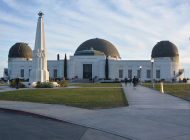
Construction of the observatory was overseen by architects John C. Austin and Frederick M. Ashley, with consultation by Russell W. Porter, a pioneering telescope maker of the period. Porter was instrumental in establishing the 67,000 square-foot Art Deco building’s distinctive look and character, as well as the longstanding exhibitions.
“Porter came up with all kinds of concepts of how the building should look and what should be built into it,” Krupp said. “He understood the need for both the solar telescope and the nighttime telescope, and helped specify how those would go in. He was key in developing the three-dome concept. The trademark silhouette of Griffith Observatory with its three domes is very much a part of the different concepts that Porter was pulling together.”
The observatory has largely remained unchanged over the decades, maintaining many aspects of Porter’s original ideas including the Foucault Pendulum, which charts the rotation of the Earth and serves as a focal point in the entry rotunda. As the building entered the new millennium, the observatory underwent a four-year, $93 million renovation that upgraded the facility for generations to come. When it reopened in 2006, visitors were introduced to fresh features such as the Leonard Nimoy Event Horizon Theater, which shows films and hosts special programs and presentations exploring the secrets of the universe.
Krupp said the 90th anniversary year has focused on celestial observations, and a major aspect has been tracking the trajectory of the moon, which is rising at its farthest point to the north and setting at its farthest point to the south in an 18.6-year cycle.
“In November and in December, in the early evening, we’ll be picking up the northern moon. We have lines on the ground here [marking where the moon rises]. We have already done that with the moon earlier in the year, and we’ll be doing it again as the year closes out,” Krupp added.
Visitors are also invited inside to view the observatory’s exhibitions and immerse themselves in exciting remote worlds.
“We have a passport for everybody at the observatory, and you can actually go through the whole building with a checklist of things and get them stamped and checked off, things that we want to make sure people don’t miss,” Krupp said. “And of course, they walk away with a nice souvenir of the place and a record of their visit.”
Krupp, director since 1974, said every day at the Griffith Observatory is a new experience. He delights in seeing visitors’ responses when they see or learn something new and said he is privileged to have long been part of such an important Los Angeles institution.
“I am just charmed always by whatever delight that I manage to encounter, and I see it every day, no matter where I look in the building. The discovery that someone has just made, something that they didn’t even think about before and suddenly it has connected. They see Saturn for the first time through a telescope and to see their jaw drop,” Krupp said. “There is always a string of things to be seen here and you realize you’re giving pleasure to one person after another. There’s just so much to see and enjoy at the Griffith Observatory.”






0 Comment