





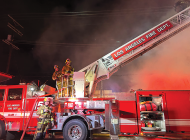
(photo by Tabor Brewster)
When the sun rose around 7 a.m. on Jan. 7, 2025, high winds were already whipping across the Los Angeles area, a foreboding warning to the disasters that would befall communities in the Pacific Palisades and Altadena later that day.
Wind-driven fires are among the most dangerous and unpredictable emergencies, according to the Los Angeles Fire Department, and the winds on Jan. 7 were unlike any the Los Angeles area had experienced. It would turn out to be a life-changing day for thousands of people across the city.
For LAFD Capt. Erik Scott, a public information officer whose responsibility that day was to keep the public informed about the winds and fire activity, Jan. 7 was a day he will never forget. It was the first of a 28-day deployment in which he worked nearly non-stop, as did his approximately 3,600 LAFD colleagues. Scott said he is proud of the courage shown by firefighters who battled to save lives and property, and he is confident they did all they could in the face of an extreme situation. Scott added, however, that his pride is contrasted by knowledge that at least 30 people lost their lives and thousands lost homes and properties during some of the worst fires in Los Angeles’ history.
“That wind was the most significant, most powerful, most relentless wind I’ve ever experienced in my 25 years as a first responder including 20 with LAFD,” Scott said. “There was no stopping that fire until the wind stopped.”
Scott said although the wind was blowing strong during the morning of Jan. 7, firefighters believed they had enough resources to address the situation. He said a small brush fire erupted around 10 a.m. on a hillside above the Sunset Strip in West Hollywood, and firefighters quickly doused the flames and prevented it from spreading. At the time, the winds hadn’t reached the point where helicopters could no longer fly, and water drops helped firefighters extinguish the blaze quickly.
To ensure the public stayed informed, Scott was deployed to an area off the 405 Freeway in the Sepulveda Pass which burned in the 2017 Skirball fire. He held a press conference to outline the dangers of wind-driven fires and what people should do to prepare.
“I was concerned about the public. It was Jan. 7, not July and August with really increased temperatures, and I was worried that they maybe weren’t going to take the precautions necessary,” Scott said. “And at 10:30 [a.m.], a fire pops up in Pacific Palisades and we were all monitoring that. We were right off the freeway, the 405 and the Skirball parking lot, and I heard rather quickly that one of the first arriving resources called for 10 additional units. I knew right away that what they were seeing warranted a quick response, so I headed that way.”
Scott joined a line of fire engines heading toward the Pacific Palisades. As the convoy drove west along Sunset Boulevard, he said the gravity of the situation came into focus.
“I remember looking across the passenger seat through my righthand window and I could see a significant column of smoke,” he added. “I knew immediately we were going to be in this for the long haul. That day turned into 28 days straight.”
Scott said the days that ensued are largely a blur – filled with myriad duties centered on ensuring the public had the most-up-to-date detailed information. In looking back, Scott said the winds on Jan. 7 are what he remembers most, a frightening reminder of the power of Mother Nature. Helicopter water drops were not an option during heavy gusts, and personnel on the ground faced an unrelenting battle.
“I had my brush helmet on, and the back of your helmet’s got a little black dial that you turn to the right to tighten it. I was cranking that thing down so hard because the wind was so relentless. As you turned that dial, it would just pop at some point. That’s as tight as it could get on your head,” he said. “As you walked around you would have embers glowing and blowing past your face and hitting you in the cheeks and your ears. My helmet would start to rip off. And that was just an example of how significant the winds were. You would see our guys trying to put out fires and what would be just a normal straight stream pattern to hit a target was ripped 90 degrees to the right from the wind gusts. They readjusted their stream, and then it whipped the other way. It was just so difficult even to put water on the fire.”
Through it all, Scott said the LAFD persevered, and despite the devastating losses, he said the department did its best to rise to the challenge.
“Our aircraft were out of the fight, and it became a relentless ground fight that was even more challenged by multiple fires continuing to break out in the Los Angeles region,” he said. “With the resources we had, I will tell you wholeheartedly, your Los Angeles firefighters could not have fought harder.”

LAFD Capt. Erik Scott. (photo by Adam Vangerpen)





0 Comment